
1. After watching the film, did the events in the movie change your viewpoint of the war? If so, how and what made it changed?
When we think of the Second World War, we think of it as a battle of millions, tanks, airplanes, and e.t.c. A War is technically all about physical combat to see who can kill the most people with weapons. However, watching The Imitation Game made us realized that the Second World War wasn’t just a battle with physical force, but also a battle with the mind. At first, it seems like most of the battles were won by the military themselves, but the film was able to show us that these battles were won because of the intelligence Turing supplied. It made us look at the war with a more diverse perspective, such as strategies, civilians, and especially coded messages used during the war.
2. Why and how did Alan Turing’s actions impact the world? How different would the world be if it wasn’t for Alan and his team?
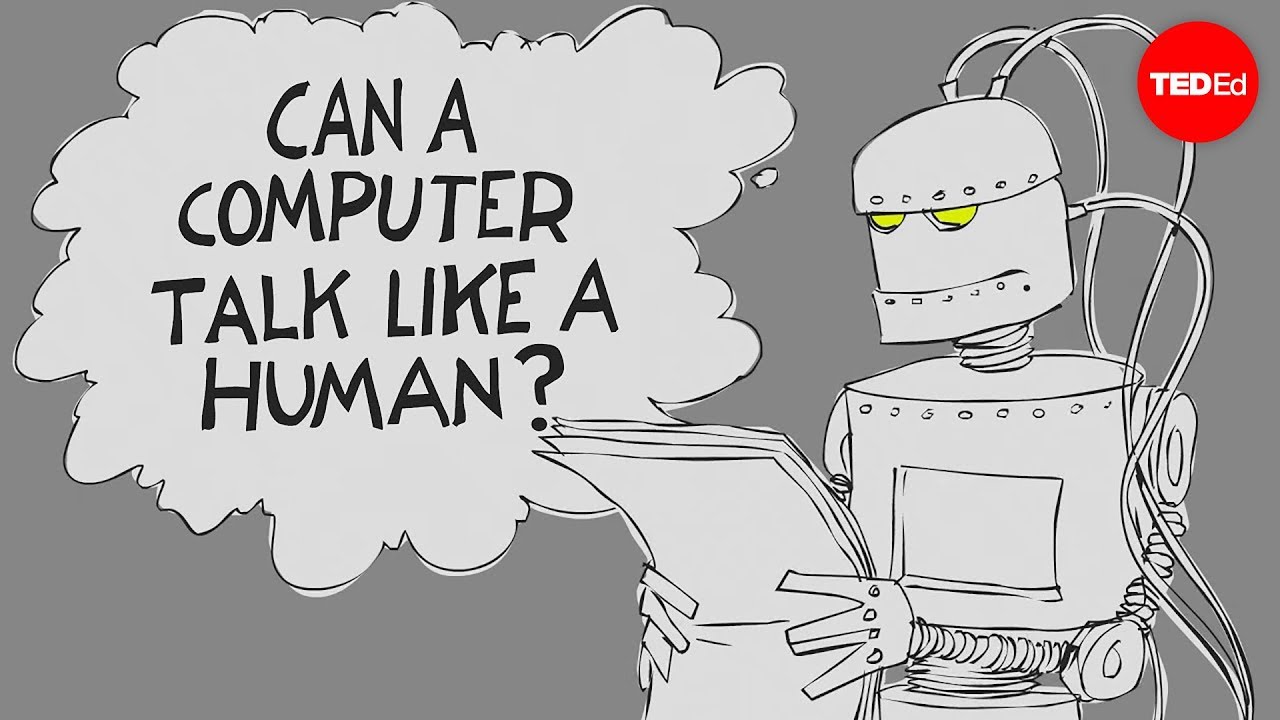
We all know that Turing’s contribution helped the Allies to victory, but there were much more to that. His Turing machine not only played a huge role in the war, but it also opened a world of computers. At the 1950s, the business quickly saw the benefits of computers and business computing became a new industry. Surprisingly, these machines were all universal Turing Machines, you know, the one Alan invented. His invention of the “Turing Test” increased the aspects of AIs in our daily life. We now have Apple Siri, Satellite navigation system, and even self driven cars. If Alan did not exist and the Turing Machine was not invented, would people in the future even use computers? His contributions to the war not only changed the outcome of the war, but also changed human technological development.
3. Although the movie did not mention the Holocaust, can you make a connect with the events in the story to the Holocaust? If so, explain why with historical evidence to support your answer.
Although the movie did not mention the Holocaust, there were some coded messages that contained details on events of the Holocaust. According to New York Times, one of the messages intercepted on January, 11, 1943 contained details on the 1,274,166 Jews being killed at four death camps. This proves that the Nazi not only used coded to communicate about the war, they also used them to communicate the extermination of the Jews. Which reflects to the theme of methodology.
4. In the movie, how did they show the political issues back then, and how did it affect Alan Turing?
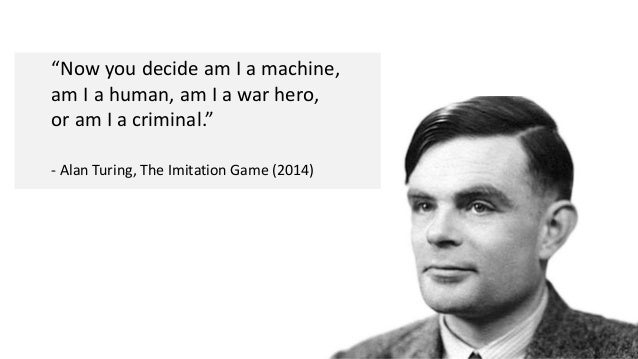
The epilogue of the movie shows that between 1885 and 1967, approximately 49,000 homosexual men were convicted of gross indecency under British Laws. Alan Turing was one of these 49,000 thousand people. Apparently, the side effects of hormonal therapy were so severe that he committed suicide a year later he was convicted on June 17th, 1954.
5. The movie stated that historians argued that Alan shorten the war by 2 years. Is that true and historically accurate? Would the outcome of the war change if Alan did not crack the Enigma Code?
Sure, solving the Enigma code gave away the Nazi’s position and it helped to win the war, but saying that it shorten the war by 2 years is absurd. Especially when there’s no concrete evidence of why cracking the Enigma was so important. Now would the outcome of the war changed without him? Yes, but also no. Cracking the codes definitely lead the Allies to victory because it allows them to coordinate every German’s move. Just think about fighting a war with a map given to you that indicates all of the enemy positions. On the other hand, the outcome of the war probably won’t change without him. This is because someone else will probably eventually do the same thing Alan did, but it would just take longer to find that person. Even if Alan did break Enigma, we must also consider the fact that the Soviets were already winning the war on the Eastern Fronts, most of the Soviet territories were recaptured before the D-day landing. Although the movie did say that the battle of Stalingrad was won by enigma codes, there is a lack of evidence to show that’s true. It could be possible that the Soviet could’ve won the war by themselves. The Enigma code was rarely shared with the USSR as well (only with spies), so the Enigma barely played a role in the Eastern front. Therefore, there isn’t really a correct answer.





 The Imitation Game Historical Review