Alan Turing Film vs Real Life

Image result for alan turing film vs real life

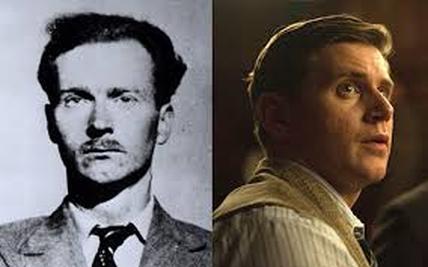
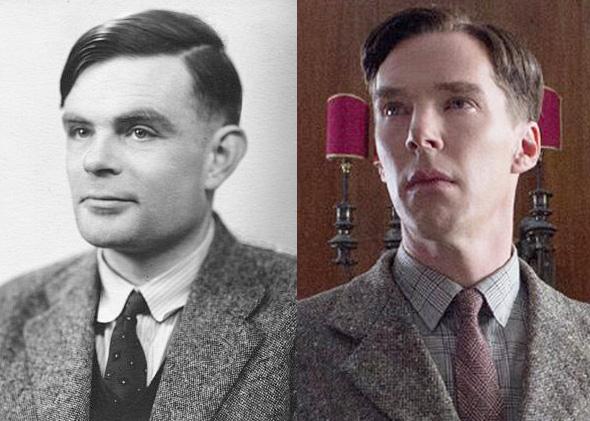
On the picture above, you can see a comparison of Benedict Cumber-batch (actor for Alan Turing) and Alan Turing himself. These two doesn’t look the same, but they are from the same region. In fact, both of them were born in London, England. In this post, I will be comparing both Alan Turing from the movie and Alan Turing from real life to identify the historical accuracy in the film.

Turing story compared to his real self is very similar and the movie did a good job in replicating the autobiography of Alan Turing. In the film, there were nice historical connections to Alan’s life. An example of this would be his death. The real Alan Turing died from cyanide poisoning at his home in Wilmslow, Cheshire. Although the movie did not show the actual suicide, there are many clues that his suicide will eventually occur. At the beginning of the film, when the police went into his house. He mentions that he was “experimenting” with cyanide and told the police officer to leave. This quickly followed by one of the officers stating: “Alan Turing is definitely hiding something.” This quote is quite ambiguous because what the officer said could mean Turing is hiding his Turing device, or hiding his attempt to suicide. This scene is brilliant at giving a nice foreshadowing at the beginning of the movie. Another good connection is the “Turing Test”. The Turing Test was developed by Alan Turing in the 1950 with the sole purpose of to test if a machine have intelligence that’s indistinguishable from a normal human. Throughout the film, Alan Turing was shown to be in an interrogation room. He mentions about the “Imitation Game” which is unsurprisingly the same name as the movie title. In fact, this “Imitation Game” is actually referencing to the original “Turing Test”. How this game works is that the judge would ask questions to the machine or human and both of them will answer that question. After that, the judge would  have to guess who responded. In the film, after Alan explained everything, he questioned the interrogator and said: “So after listening to what I have to say, am I a machine, or a human?” Similar to the Turing Test, the interrogator must decide whether the person speaking is a machine or a human. Instead replacing the the word machine and human with war hero and criminal. The war hero would mean that he believes in Alan, and his story would be released to the public. On the other hand, the criminal would mean that the “Turing Test” failed and he believes that Alan’s contributions are nothing but fantasies. This connection to the basic theory of the Turing Test added a nice historical value and recognition for Alan invention of it.

Their personality are somewhat similar, except that the Turing in the film is exaggerated. In the film, Alan Turing was shown as someone on the Autism Spectrum. His speech pattern is very choppy and he has difficulty working with others. His colleagues would call him “Arrogant”, “Narcissistic” and most specifically a “Monster”. It is also the last word Joan Clarke said to Turing before they broke up in the movie. In this manner, the movie is clearly trying to portray Turing as a horrendous person. This is where the historical inaccuracy comes in, because sure he was shy, but they took it too far. Although the movie was able to show that Turing was shy and outspoken,  he wasn’t arrogant or a “Monster” that would treat people like rats. In his real self, he is a delighted and frivolous person that’s respected by his people. There are people out there that knew Alan Turing when he was alive and said that Turing was never an arrogant bastard. This whole “arrogant” personality is only there for dramatization and character depth. Adding a fictional theme of “Treat people the way you want to be treated.” This might’ve improved the character development, but it is certainly out of historical context.

To sum up, the events in the movie reflects Alan Turing’s story very well, but there were also some inaccurate events such as the Soviet spy being in the film. The biggest problem would be his personality being over exaggerated in the film. Which ruins the reputation of Alan Turing.

 

Development of Study and Historiography development


Image result for computer science

Alan Turing with his invention of the Turing Machine, sparked many development of study and historiography development. A field of study, which is known as Computer Science today was the result of Alan Turing’s machine. The Turing Machine, was the foundation of modern computers today. Modern computers now use binary logic, which operates exactly like the Turing Machine. Although the machines today are totally more advanced, Turing offered a basic idea of a programmable machine. So none of the newer computer would exist if it wasn’t for Turing’s basic theory of computation machines.

The few years after the war, he focuses on Artificial Intelligence and published a paper in 1952 about his Turing hypothesis. Which is why artificial intelligence is so advanced in the modern days. His contribution to the development of study is immense, definitely the paramount person for the computer and AIs we have today. His contribution to the development of study, were not shown in the film unfortunately, but that’s fine because the movie catches more on his life rather than the technical values.

Image result for turing test

Not only did he changed computer science and artificial intelligence, but his historical value is worth mentioning today. Him breaking the enigma code prevented the German from invading Britain, stopped German U-boat assault, won the D-day battles and more. It is worthy for historians today to recognize Turing more for his contributions to the war.


Justice/Reconciliation

Image result for justice

Alan Turing is known as a hero without any recognition. In his real self, he was sentenced for homosexual acts after the war and killed himself after the devastating effects of castration. No justice was given to him until 2009 where the queen acknowledged his achievements and made an apology.  Some might say that his justice is given by the apology, but it’s not really justice when the person receiving it is dead right?  How would Alan Turing receive the justice if he is already dead? At the end, he died without anyone acknowledging his achievements. The movie did exactly that to show that there was a lack of justice given to Alan Turing.

There was also a lack of reconciliation in Alan Turing’s life as well. After the war, he had never seen any of the members in MI6 ever again, and died a lonely death. In the movie however, they did show this theme of reconciliation at the end of the movie, which means it does not represent Alan Turing’s life accurately.  It is shown when Joan Clarke visited his house, and encouraged him that what he accomplished during the war is immeasurable. This particular scene would be considered historically inaccurate, and took away the tragedy of Alan Turing’s death by a little.

Conclusively, Justice and Reconciliation are both important themes in the movie. The movie proved that justice was not given to any of the members of MI6, the worst case being how Alan Turing was killed without any acknowledgement of his contributions to society. However, the film presented reconciliation differently than the real event which took away the melancholy mood of the ending.


Legacy/Aftermath


Alan Turing: Computation

After the war, Alan Turing received a very rich legacy for his contributions in WW2. Not only for building the Turing Machine, but also for his other contributions. In 1942, he made the Navel Bombe, which is a decryption device that specifically reveals enemy U-boat locations. He also broke through not only the Enigma code, but telephone conversations as well in 1944. Even after the war, Alan Turing made the first ever chess computer program, where the AI won against his friend in 29 moves. Of course don’t forget that his Turing machine is the model used for all modern computer and he is also the founder of computer science. So Alan Turing’s legacy is not only rich because of his role in WW2, but also from how much he impacted the technologies in the world in the 1940s – 1950s.  In the movie, his legacy is shown towards the end of the film, which explains his contribution to World War 2 . Alan stated that his decryption allowed the battle of Normandy to occur, which is also known as D-Day. He also stated that the battle of Stalingrad was won because of his coded intelligence. This is mainly because John Cairn-cross gained copies of the documents and gave them to the Soviets, some containing information about Stalingrad. Unfortunately, there isn’t enough evidence to prove if that’s true or not, but if Turing really did ended the battle of Stalingrad, that means he is responsible for the first Nazi defeat in the war. Which is another huge contribution to WW2.  Just think about how differently the world would be, if it wasn’t for Alan Turing.

As much as how rich his legacy was, what happened right after the war was a terrible experience for not only Alan Turing, but his entire team. Basically, the manager of the MI6 just went up to them and said: “You cracked the code, nice!!!! Now go back to your home and never talk about it ever again.”. These people literally won a war on a global scale, and none of them received any recognition, honor, or legacy (at that time). This section of the film reflects the horrendous aftermath for these cryptanalysts in their real self. Especially for Alan Turing when he was being thanked with criminal prosecution.

Overall, the movie did a good job in expressing the theme of legacy and aftermath.  Many scenes in the movie captivated Alan Turing contributions to the war, which is also his legacy. The ending of the film also shown the devastating aftermath of Alan Turing’s life.  The  historical accuracy is strong with this one.

Systems and Mechanisms for killing.

Image result for nazi's coded messages in ww2

The important of signal intelligence became evident since the first World War, these communications were used to transmit messages to the military and allies secretly. One of the key strategies for the Nazis was to use secretly coded messages as an offensive tools. In “The Imitation Game” and real life, these codes mainly reveal every secret convoys, surprise attacks, bombing runs, and U-boat assaults. Allowing the Nazis to carry out their operations more methodically and strategically.

However, Turing’s “Turing machine” is much stronger than the Enigma. It is powerful enough that they can turn the Nazi’s weapon and use it against them. By cracking the code, they can use the Nazi’s messages to counter their attacks. Now the Nazis intelligence is a very important weapon for the Allies as well. In the film, Turing and his team made a map that located the location of every German’s boat, U-boat and airstrike. After 2 more years of decoding more Enigma codes, the war eventually came to a stopped because of the immense intelligence Turing supplied. Just like the movie, many battles in WW2 were proven to have won by the Allies because of the decoding. The location on the airstrike/bombing runs prevented Hitler from invading Britain. By 1943, the Allies made further advances in tracking the German communications and U-boat movements, which lead to the victory of “The Battle of the Atlantic”.

This wasn’t mentioned in the film, but the Enigma code is also connected to the events of the Holocaust. Information regarding the mass killings of Jews became to spread to the world in late June 1941. By 1942, there were reports of the Nazi’s “final solution on the Jews”, including, details on methods,  locations, and numbers. These information were reached by the Allies and most importantly the British Intelligence. Which means that it is possible that some of the reports were coded into the Enigma machine. By December 17, 1942, the Allies actually declared that they would be condemning the perpetrators for the extermination of Jews, which means that they’ve already knew about the Holocaust around 2 years before discovery of the camps. Therefore, there is a possibility that coded messages were used to carry on the Jews extermination a.k.a the Holocaust. Although the movie did not show this connection, it is something that possibly happened in real life. It would be nice if the film added some connections or context to the Holocaust during that time, but the movie was still good without that connection.

Source: https://www.jewishvirtuallibrary.org/when-did-the-world-find-out-about-the-holocaust


Perpetrators, Collaborators, and Bystanders

Image result for john cairncross

The film portrayed the villains as not only the Nazis, but also some of the allies as well. Some of the MI6 agents are Soviet spies, especially one of his colleagues in hut 8. The spy that is shown in the movie, John Cairn cross is one of them. He was the one that showed the Soviets that the British were breaking codes. At that time, he were able to send 5,832 documents between 1941 and 1945. In the movie, he was shown as one of Turing’s coworkers and they are quite close as well. Unfortunately, this section of the film is historically inaccurate. For John Cairn-cross, although he did join the MI6, he never worked for or with Turing. Therefore, these two probably never met, making this controversy with having one of Turing’s colleagues being a Soviet spy fictional.  Despite it not being historically accurate, it still gave an interesting viewpoint of what the other countries are doing. The Soviets during that time were fighting against the Nazis. So having access to encrypted German codes that contain information all bout strategic attacks will definitely help them get to Berlin faster. This shows a connection how solving the Enigma code gave not only the Western side an advantage, but also the Eastern side.


Homosexuality as an offence(Relation to Politics)

Image result for arnold murray and turing

SPOILERS ALERT!! In the movie and in real life, male homosexual acts were illegal and could be punished by imprisonment if caught. Unfortunately, Alan Turing fell victim in the punishments for being a homosexual himself. He was either given a choice for a two year prison sentence or a chemical “castration” which is the one he chose and that left a devastated impact on his mental behavior. At the end of the film, when Joan Clarke visited his home, he was shown to be suffering from severe twitching and can’t even pick up a pen to finish the crossword puzzle. This ultimately left to his suicide the next year and no justice or even acknowledgment was given to him until 2009. All of this reflects nicely to what happened to the real Alan Turing. In 1941, Turing purposed to Joan Clarke, but the engagement didn’t last very long. After telling his wife about his homosexuality, he decided to abandon the marriage. This event was portrayed in the film exactly the same as the real event, so are other parts about his homosexuality. The only historical inaccuracy would be at the beginning of the film, where it shows Turing denying the police. In his real self however, he actually reported the crime to the police.