
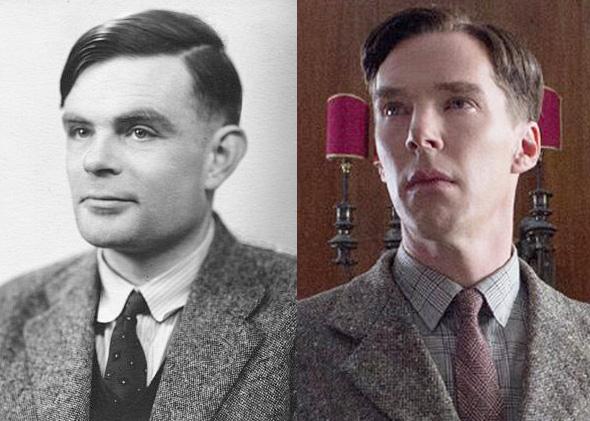
On the picture above, you can see a comparison of Benedict Cumber-batch (actor for Alan Turing) and Alan Turing himself. These two doesn’t look the same, but they are from the same region. In fact, both of them were born in London, England. In this post, I will be comparing both Alan Turing from the movie and Alan Turing from real life to identify the historical accuracy in the film.
Turing story compared to his real self is very similar and the movie did a good job in replicating the autobiography of Alan Turing. In the film, there were nice historical connections to Alan’s life. An example of this would be his death. The real Alan Turing died from cyanide poisoning at his home in Wilmslow, Cheshire. Although the movie did not show the actual suicide, there are many clues that his suicide will eventually occur. At the beginning of the film, when the police went into his house. He mentions that he was “experimenting” with cyanide and told the police officer to leave. This quickly followed by one of the officers stating: “Alan Turing is definitely hiding something.” This quote is quite ambiguous because what the officer said could mean Turing is hiding his Turing device, or hiding his attempt to suicide. This scene is brilliant at giving a nice foreshadowing at the beginning of the movie. Another good connection is the “Turing Test”. The Turing Test was developed by Alan Turing in the 1950 with the sole purpose of to test if a machine have intelligence that’s indistinguishable from a normal human. Throughout the film, Alan Turing was shown to be in an interrogation room. He mentions about the “Imitation Game” which is unsurprisingly the same name as the movie title. In fact, this “Imitation Game” is actually referencing to the original “Turing Test”. How this game works is that the judge would ask questions to the machine or human and both of them will answer that question. After that, the judge would have to guess who responded. In the film, after Alan explained everything, he questioned the interrogator and said: “So after listening to what I have to say, am I a machine, or a human?” Similar to the Turing Test, the interrogator must decide whether the person speaking is a machine or a human. Instead replacing the the word machine and human with war hero and criminal. The war hero would mean that he believes in Alan, and his story would be released to the public. On the other hand, the criminal would mean that the “Turing Test” failed and he believes that Alan’s contributions are nothing but fantasies. This connection to the basic theory of the Turing Test added a nice historical value and recognition for Alan invention of it.
Their personality are somewhat similar, except that the Turing in the film is exaggerated. In the film, Alan Turing was shown as someone on the Autism Spectrum. His speech pattern is very choppy and he has difficulty working with others. His colleagues would call him “Arrogant”, “Narcissistic” and most specifically a “Monster”. It is also the last word Joan Clarke said to Turing before they broke up in the movie. In this manner, the movie is clearly trying to portray Turing as a horrendous person. This is where the historical inaccuracy comes in, because sure he was shy, but they took it too far. Although the movie was able to show that Turing was shy and outspoken, he wasn’t arrogant or a “Monster” that would treat people like rats. In his real self, he is a delighted and frivolous person that’s respected by his people. There are people out there that knew Alan Turing when he was alive and said that Turing was never an arrogant bastard. This whole “arrogant” personality is only there for dramatization and character depth. Adding a fictional theme of “Treat people the way you want to be treated.” This might’ve improved the character development, but it is certainly out of historical context.
To sum up, the events in the movie reflects Alan Turing’s story very well, but there were also some inaccurate events such as the Soviet spy being in the film. The biggest problem would be his personality being over exaggerated in the film. Which ruins the reputation of Alan Turing.
 The Imitation Game Historical Review